English
 English

AQI improves marginally in Delhi-NCR
New Delhi: The air quality in the capital Delhi was recorded in the "poor" category on Tuesday. A thin blanket of smog enveloped many parts of the city, affecting visibility. According to the Central Pollution Control Board, the air quality index in the national capital was 292 at 8 am.
The AQI in these areas of Delhi was as follows:
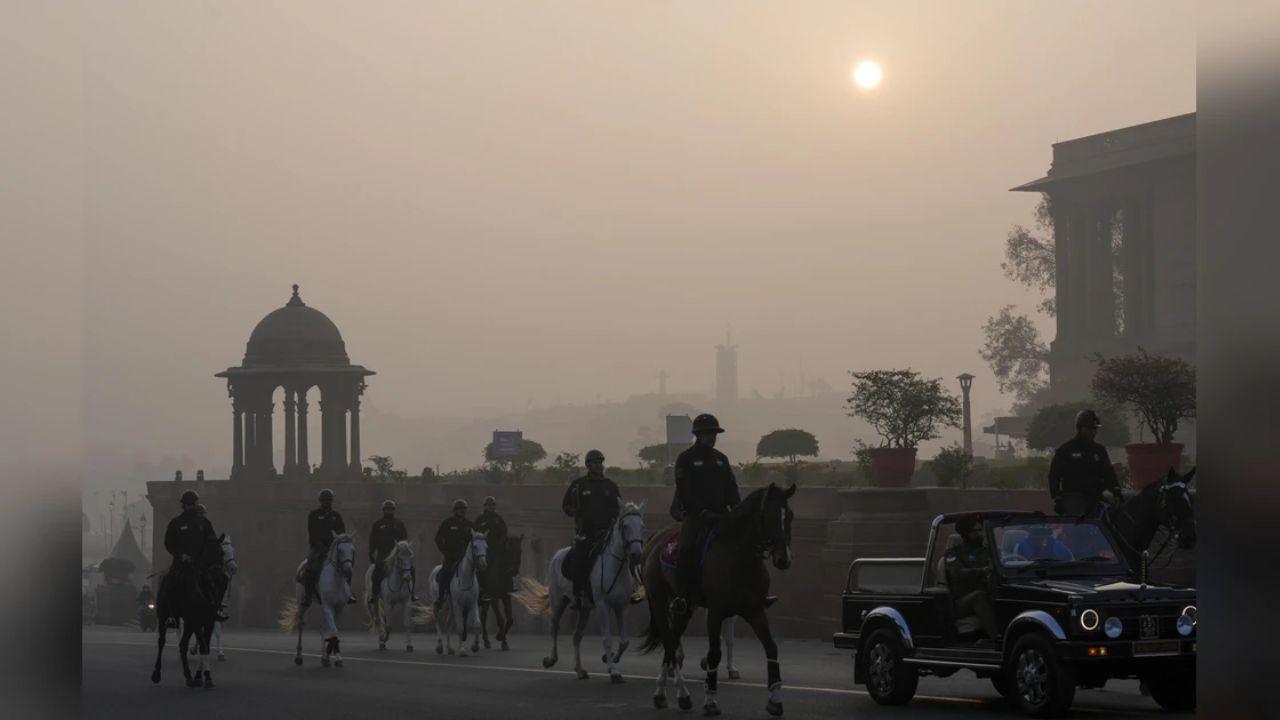
Light haze was visible early in the morning at India Gate and Kartavya Path. The AQI around these areas was recorded at 265, which falls in the "poor" category. The AQI at ITO was 294, Alipur 282, Aya Nagar 253, and Burari 291.
Pollution levels remained particularly high at Akshardham, where the AQI reached 319, which falls in the "very poor" category. Similar conditions were observed in Ghazipur and Anand Vihar, where the AQI was recorded at 319.
The AQI also remained in the very poor category at several other major stations, including 305 in Ashok Vihar, 342 in Bawana, 319 in Anand Vihar, 333 in Chandni Chowk, and 314 in Dwarka.
Delhi's Air Poor
Monday morning began with haze and light fog. A light layer of smog also appeared in the sky, reducing visibility. People were seen wearing masks during this time. Respiratory problems also arose.
The Air Quality Index (AQI) was recorded at 314, which falls in the very poor category. This marked an increase of six points compared to Sunday.
NCR's Air
On the other hand, Noida's air remained the most polluted in the NCR, recording an AQI of 330, which falls in the very poor category. Ghaziabad recorded 309, Greater Noida 302, and Gurugram 278. Faridabad's air remained the cleanest. The index here was recorded at 203, which is in the poor air quality category.
According to the Decision Support System for Air Quality Management in Delhi, vehicular pollution accounted for 17.58% of the total pollution. Residential areas contributed 4.2%, construction activities 2.4%, and peripheral industries 8.42%. According to the CPCB, on Monday, winds blew from the northwest at a speed of 20 kilometers per hour.
The estimated maximum mixing depth was 900 meters. The ventilation index was 6000 meters per square second. Meanwhile, at 1 p.m., the PM10 concentration in the air was recorded at 250.2 micrograms per cubic meter and PM2.5 at 138.8 micrograms per cubic meter.
The Central Pollution Control Board (CPCB) predicts that the air will remain in the very poor category until Thursday. This will cause problems for respiratory patients and may also cause eye irritation. Also, air quality was recorded in severe and very poor categories in many areas.