 English
 English

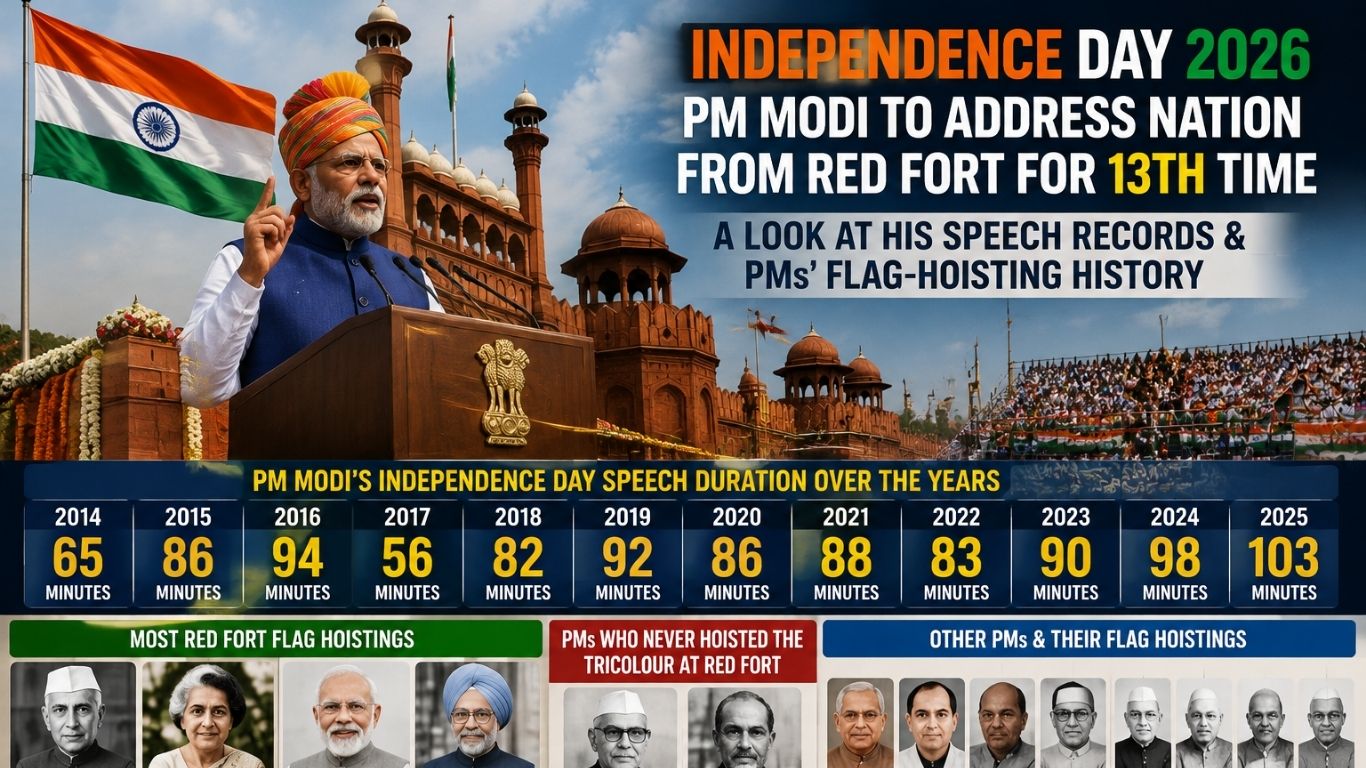
PM Narendra Modi addresses the nation from the ramparts of the Red Fort on India's 80th Independence Day
New Delhi: Prime Minister Narendra Modi on Saturday brought the women’s reservation issue back into the national spotlight after appealing to all political parties to support 33 per cent reservation for women in Parliament and state assemblies. The move revived a long-running political debate over women’s representation, constitutional procedures and the future structure of India’s electoral system.
Addressing the nation from the ramparts of the historic Red Fort on India’s 80th Independence Day, PM Modi said women are progressing rapidly across sectors and their larger presence in legislative bodies is essential for shaping policies and strengthening democracy. He urged political parties to work together to ensure greater participation of women in decision-making institutions.
During his 13th consecutive Independence Day address, PM Modi highlighted the increasing role of women in politics, administration, business, technology and grassroots governance. He referred to the Nari Shakti Vandan Adhiniyam, 2023, which provides for 33 per cent reservation for women in the Lok Sabha and state legislative assemblies.
The Prime Minister said women representatives in Panchayats, Municipalities and Municipal Corporations have already demonstrated strong leadership by addressing local issues and improving governance at the grassroots level. The renewed focus has once again placed women’s political representation at the centre of public discussion, with supporters calling it a major step towards gender equality.
Seeking consensus, Prime Minister Modi urged all political parties to support women’s reservation and avoid turning the issue into a political confrontation. He said the priority should be empowering women and ensuring their participation in policy-making rather than engaging in political competition over credit.
According to PM Modi, stronger representation of women in Parliament and state assemblies would lead to more inclusive governance, better policy decisions and wider participation in nation-building.
Highlighting the contribution of women leaders at the local level, PM Modi said women representatives in Panchayats and urban local bodies have played an important role in solving public issues.
Women leaders have increasingly contributed to areas such as healthcare, education, sanitation, welfare implementation and community development. The Prime Minister suggested that expanding this representation to higher legislative institutions would further strengthen India’s democratic framework.
PM Modi: The youth have a very important role in the journey towards a developed India. They will also be the biggest beneficiaries of Viksit Bharat. India’s young generation carries the energy, innovation and determination to shape the nation’s future. The dream of Viksit Bharat… pic.twitter.com/fTBAb0C2Al
— Dynamite News (@DynamiteNews_) August 15, 2026
The women’s reservation law has been one of India’s most debated political reforms. Although the legislation was passed by Parliament, its implementation involves constitutional and administrative procedures.
The government has linked the implementation of the 33 per cent quota with the delimitation exercise, which involves restructuring electoral constituencies and determining future seat distribution in Parliament and state assemblies.
Opposition parties have questioned this approach and demanded that women’s reservation should be implemented within the existing strength of legislatures instead of waiting for delimitation. The disagreement has turned the issue into a wider debate over constitutional amendments, electoral reforms, social justice and political representation.
The women’s quota issue is expected to remain a major political talking point as parties prepare for future elections. While most political groups support the idea of increasing women’s representation, differences continue over the timing and process of implementation. The key questions remain around the role of delimitation, seat allocation and the constitutional framework required to operationalise the reservation.
Sports development was another major highlight of the Independence Day speech. PM Modi said India is preparing to become a strong contender for hosting the 2036 Olympic Games. He announced a nationwide talent identification programme to discover young athletes between five and 15 years of age. The initiative aims to strengthen India’s sports ecosystem and create a pipeline of future champions.
Prime Minister Narendra Modi: We have resolved our aspiration to host the 2036 Olympic Games in India. However, looking ahead to 2036, in all those sporting disciplines where India does not compete today, where India fails to qualify, and the events that have remained… pic.twitter.com/YQJuqk6DLn
— Dynamite News (@DynamiteNews_) August 15, 2026
The Prime Minister also highlighted India’s progress in education and healthcare sectors, including the expansion of universities and medical education opportunities. He also appealed to citizens, especially young people, to participate actively in the Census process and provide accurate digital information for better national planning.
PM Modi’s Red Fort speech has once again pushed women’s reservation into the centre of India’s political conversation. The next phase will depend on the government’s implementation roadmap, opposition parties’ response and progress on constitutional procedures.
With electoral reforms, gender representation and inclusive governance becoming key political issues, the debate over 33 per cent women’s reservation is expected to remain a major national discussion.