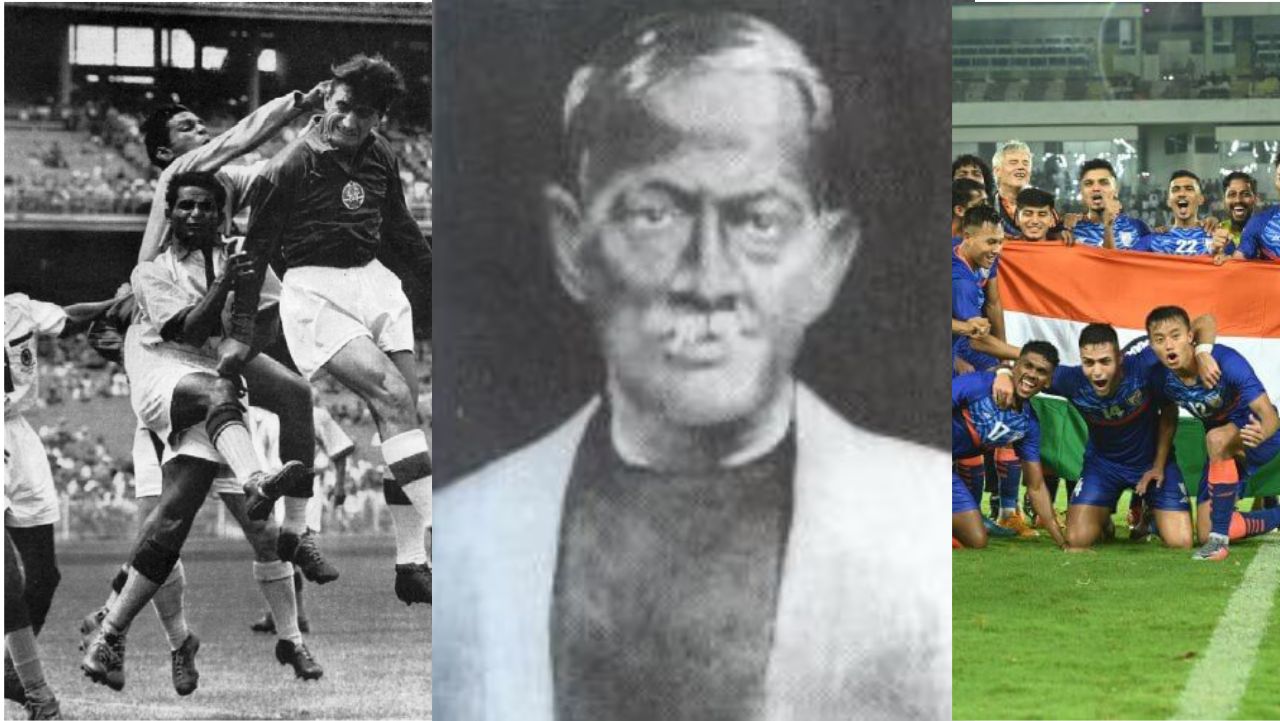
From Barefoot Heroes to a World Cup That Never Was in Faith (Img: Dynamite News)
Kolkata: From Kolkata’s narrow lanes to Kerala’s football-mad towns to Bengaluru’s cafés and the playgrounds of the North-East, India is preparing for another sleepless football night. Just before the stage is set for the FIFA World Cup final match. Here is a look at Indian Football.
Argentina and Spain will contest the FIFA World Cup 2026 final on July 19. Jerseys, flags and familiar match-day superstitions have already returned as Lionel Messi’s Argentina prepare to face a young Spanish side.
An Argentina fan, Rajiv Kumar, a Medicial representative while talking to Dynamite News said, "This Final is do or die for as Argentina fan and I have given puja in the name of Messi, so that he picks up the World Cup for the second time."
Also Read: Messi vs Mbappe: Who Will Win the FIFA World Cup 2026 Golden Boot?
Ayan Kar, a professional Architech who is a die heart fan of Spain football team said, " I remember Spain liftingt the cup in 2010 while i was in school, I want to see Spain lifting the Cup after 16 years."
India’s association with football began decades before television brought Pelé, Diego Maradona, Cristiano Ronaldo and Messi into its homes.
Nagendra Prasad Sarbadhikari, remembered as the father of Indian football, helped popularise the sport among students in colonial Calcutta. In 1887, he established Sovabazar Club with royal support at a time when organised football was largely controlled by Europeans.
The club’s formation also carried a social message. Sarbadhikari had opposed caste-based exclusion in an earlier sporting organisation, making Sovabazar part of a wider struggle for equality and Indian participation.
A retired Senior Citizen for the neighbourhood of Sovabazar, Joy Deb Chowdhury while speaking to Dynamite News said, "Nagendra Prasad Sarbadhikari's story is still now our pride as without picking up any arms, he showed Britishers their real place."
Indian football’s most celebrated colonial-era moment arrived in 1911 when Mohun Bagan defeated the East Yorkshire Regiment 2–1 in the IFA Shield final.
Ten members of the Indian side played barefoot against booted British opponents. The result was celebrated beyond the football ground because an Indian club had defeated a team representing the colonial establishment. Mohun Bagan’s official history describes the achievement as a “barefooted revolution.”
For generations of supporters, that victory remains central to the club’s identity.
A Mohun Bagan fan, Ranjit Roy who is a shopkeeper in the lanes of Kolkata said to Dynamite News, "This red green jersey is my pride and also in my blood. Just thinking about walking barefoot gives me goosebumps. I salute to the people who played barefoot."
Roy who is in his mid fifties remembers stories his grand father Sanjoy Roy told him about the match and players.
Indian football's rise did not end with the famous 1911 IFA Shield triumph. Less than four decades later, India earned qualification for the 1950 FIFA World Cup in Brazil after several Asian teams withdrew from the qualifiers.
However, the team never travelled to Brazil. While the popular belief has long been that FIFA barred India because players preferred playing barefoot, historians now agree the reasons were far more complex. Financial constraints, long travel costs, administrative priorities, limited preparation time and the All India Football Federation's greater focus on the Olympics all contributed to the decision. As a result, India missed what remains its only qualification for the senior men's FIFA World Cup.
Also Read: Eight Goals Each: Who will win FIFA World Cup golden boot, Mbappe or Messi?
For many football lovers, it remains one of the biggest "what if" moments in Indian sporting history.
Anik Mukherjee, an IT professional who hails from Kolkata, while talking about his football love to Dynamite News said, “India missing the 1950 World Cup remains one of the greatest ‘what if’ moments in the country’s football history.”
He Further said, "Even if i was not born in that era but this remains a bad memory in the mind of every football lover in India."
Although India missed the World Cup, the country's greatest footballing years were still to come. Under the legendary coach Syed Abdul Rahim, India entered its golden era with icons such as Chuni Goswami, P.K. Banerjee, Tulsidas Balaram, Jarnail Singh and goalkeeper Peter Thangaraj.
The team finished fourth at the 1956 Melbourne Olympics, still India's best-ever Olympic football performance. It then won the 1962 Asian Games gold medal, defeating South Korea 2-1 in Jakarta, and followed it with a runners-up finish at the 1964 AFC Asian Cup. During this period, India was considered one of Asia's strongest footballing nations.
Chuni Goswami, admired for his elegant style and leadership, became one of Indian football's greatest legends. Equally remarkable was his sporting versatility—he also represented Bengal in first-class cricket, making him one of the rare athletes to excel at the highest level in two major sports.
However, the decades that followed saw Indian football gradually lose its place among Asia's elite. Administrative shortcomings, inadequate grassroots investment, weak infrastructure, limited international exposure and cricket's rapid rise in popularity slowed the sport's growth. While many Asian nations modernised their football ecosystems, India struggled to sustain the success of its golden generation.
Today, academies such as Minerva, the growth of youth football and increasing international exposure have rekindled hope that Indian football can once again compete with the continent's best.
"For us, Chuni Goswami was more than just a footballer—he was the pride of Indian football. Even today, whenever we talk about India's golden era, his name comes first. Watching Spain in this World Cup reminds me of the beautiful, possession-based football that legends like Chuni Goswami inspired us to admire. His legacy will always live on in the hearts of football fans." said Deepika Nandi, a former school teacher.
East Bengal was founded in 1920 and later became closely associated with families who migrated from eastern Bengal. Its red-and-gold colours came to symbolise displacement, survival and the rebuilding of lives.
Mohun Bagan carried the pride of its 1911 victory and its association with families rooted in western Bengal. Their contest consequently became more than the Kolkata Derby.
Before a Mohun Bagan-East Bengal match, families split into rival camps, office debates become louder and neighbourhoods turn green-and-maroon or red-and-gold. Defeating the rival can rescue an otherwise disappointing season.
Also Read: ‘We Still Have a Lot to Prove’: Mbappe after France reach FIFA World Cup 2026 semi-finals
Paratha Kundu, a Charted Accounted and a East Bengal Fan said, " Bengal is always divide in green-and-maroon or red-and-gold jersey, its is also our passion and East Bengal's victory this year proves Indian football is moving forward. The next dream is to see India qualify for the FIFA World Cup."
In Manipur, Mizoram, Meghalaya, Assam, Nagaland and Sikkim, football is part of school life, village tournaments and community identity.
Shillong Lajong helped bring regional players to the national stage, while Aizawl FC’s I-League title demonstrated that a club outside India’s traditional sporting centres could become national champion.
Young players continue to emerge despite uneven facilities, expensive travel, limited funding and uncertain professional opportunities.
A recent youth triumph has added fresh optimism to the story. Chandigarh-based Minerva Academy won the 2026 Helsinki Cup in Finland after defeating defending champion HJK Helsinki 1–0 in the final. The victory made Minerva the first Indian team to lift the international youth tournament.
The result followed other eye-catching performances by the academy’s young players. In April, Minerva’s under-15 side defeated Liverpool’s under-15 team 6–0 at the Mediterranean International Cup in Spain. The Indian side’s captain scored a hat-trick in a result that demonstrated the potential emerging from organised grassroots programmes.
The Argentina-Spain final has now connected football communities across the country.
In Kerala, giant flags and public screenings reflect loyalties inherited from the Maradona generation. Goa’s club culture gives the tournament a familiar rhythm, while cafés and housing societies in Delhi, Mumbai, Pune, Hyderabad and Bengaluru are preparing for late-night gatherings.
Argentina defeated England 2–1 to reach the final, while Spain advanced with a 2–0 win over France. The contest is being viewed in India as a clash between Argentina’s experience and Spain’s fearless young generation.
Also Read: FIFA World Cup 2026: USA look to snap 24-Year Quarterfinal drought
“I’ll watch the FIFA World Cup final with my sibblings, wearing Spain team’s jersey and cheering for every goal. For us, it’s more than a match—it’s football’s biggest celebration,” said Dipankar Chowdhury, a PR professional who hails from Delhi.
When Argentina and Spain enter the field, India will divide temporarily beneath foreign flags. Behind those colours, however, will remain one shared ambition—that a future generation of Indian supporters will watch the World Cup while wearing only their own country’s blue jersey.
Deewakar a MBA Student, said "I am big fan Messi, I want to see him win and my biggest dream is to one day see India qualify for the FIFA World Cup. That moment would mean more to me than any club trophy."

