 English
 English

Economic Survey 2025–26 Presented
New Delhi: Union Finance Minister Nirmala Sitharaman presented the Economic Survey 2025–26 in Parliament today, providing a comprehensive assessment of India’s economic performance. The Survey serves as a “report card” for the government’s economic management and is traditionally tabled ahead of the Union Budget, scheduled for February 1, 2026.
FY26: A Year of External Challenges
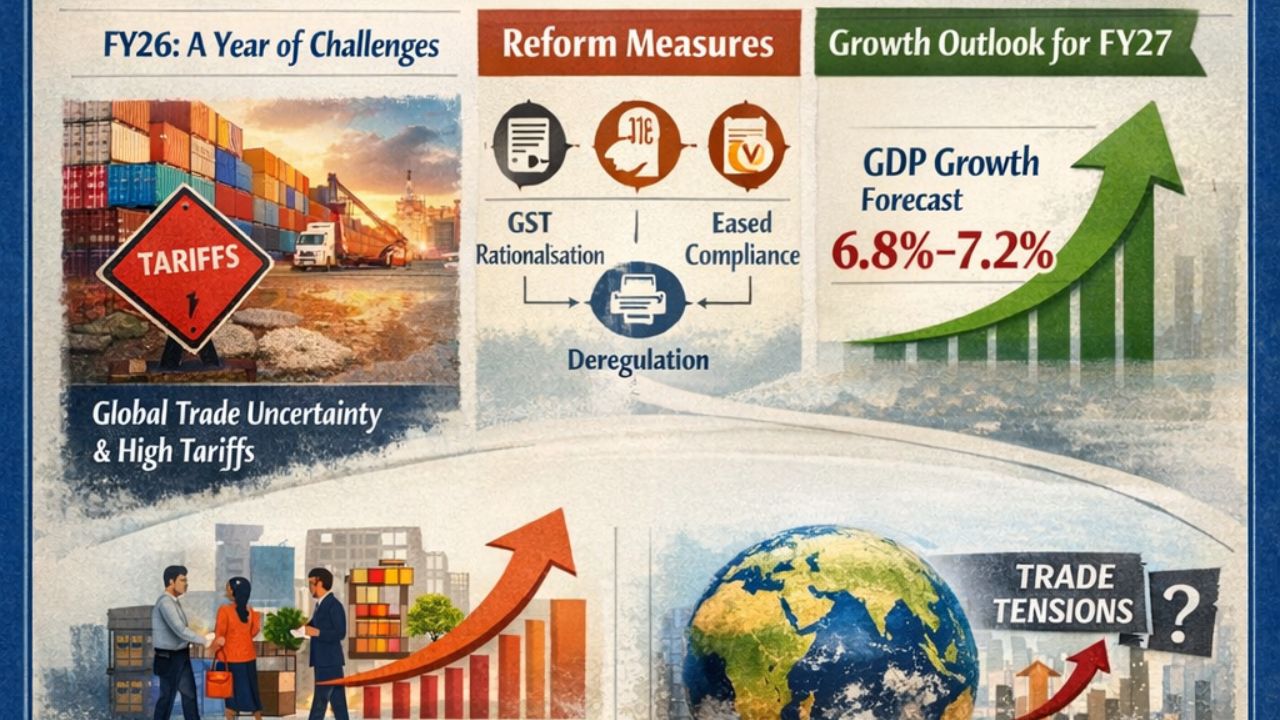
The financial year 2025–26 was marked by significant external pressures. Heightened uncertainty in global trade, coupled with the imposition of high and penal tariffs, created stress for Indian manufacturers, particularly exporters. These factors affected overall business confidence.
Government’s Response and Strategic Reforms
Despite these challenges, the government leveraged the situation to push through key reforms. Measures such as GST rationalisation, accelerated deregulation, and simplification of compliance requirements across multiple sectors were implemented. These steps aimed to enhance ease of doing business, improve efficiency, and stimulate investor confidence.
Global Economic Outlook
The outlook for the global economy remains subdued, with downside risks dominating over the medium term. Growth is expected to remain modest, keeping commodity prices broadly stable.
Inflation trends have moderated, and monetary policies are likely to remain accommodative to support growth. However, risks such as unrealised productivity gains from the AI boom or prolonged trade conflicts could disrupt asset markets and dampen investment, posing potential threats to global stability.
Outlook for FY27: Adaptation and Growth
Implications for India
For India, these global conditions translate into external uncertainties rather than immediate macroeconomic stress. Slower growth in key trading partners, trade disruptions, and capital flow volatility could intermittently affect exports and investor sentiment.
Ongoing trade negotiations with the US are expected to conclude this year, helping reduce some external uncertainties.
Domestic Economic Resilience
Against this backdrop, India’s domestic economy remains robust. Inflation has moderated, household, corporate, and bank balance sheets are healthy, and public investment continues to support economic activity.
Consumption demand is resilient, and private investment intentions are improving. These factors provide a buffer against external shocks and support continued growth momentum. The forthcoming CPI rebasing will require careful interpretation of price dynamics going forward.
Mass Layoffs: Amazon announces 16,000 job cuts amid ‘rising competition over AI’; Full story here
Overall, the Economic Survey paints a picture of cautious optimism: India is positioned for moderate growth in FY27, supported by strong fundamentals, regulatory reforms, and resilient domestic demand, even as global uncertainties persist.