English
 English

Central government clarifies DA merger status as 8th pay commission kicks off
New Delhi: The central government on Monday clarified in Parliament that it is not considering any proposal to merge the dearness allowance (DA) with the basic pay of central government employees. The statement, made in response to a question in the Lok Sabha as the Winter Session began, addresses ongoing demands from employee groups seeking early relief.
“No proposal regarding merger of the existing dearness allowance with the basic pay is under consideration with the government at present,” said Pankaj Chaudhary, Minister of State for Finance, in a written response.
The DA, along with Dearness Relief (DR) for pensioners, is revised every six months based on the All India Consumer Price Index for Industrial Workers (AICPI-IW), released by the Labour Bureau under the Ministry of Labour and Employment. This periodic revision is intended to offset inflation and protect the real value of basic pay and pensions.
8th Pay Commission: 5 Key factors that will influence your salary hike
Many employee groups and pensioners have requested that 50% of the DA be merged with basic pay as an interim measure. Their key concerns:
High inflation over the past two years has reduced real income. Merging DA with basic pay would increase the base salary, which in turn increases future DA calculations. Waiting for the 8th Pay Commission, expected to be implemented from 2026, is seen as too long for immediate relief.
Although DA is revised biannually, employee groups argue that this system does not reflect real-time inflation, leading to erosion of purchasing power. The government’s clarification signals that employees should not expect immediate financial relief through a DA merger.
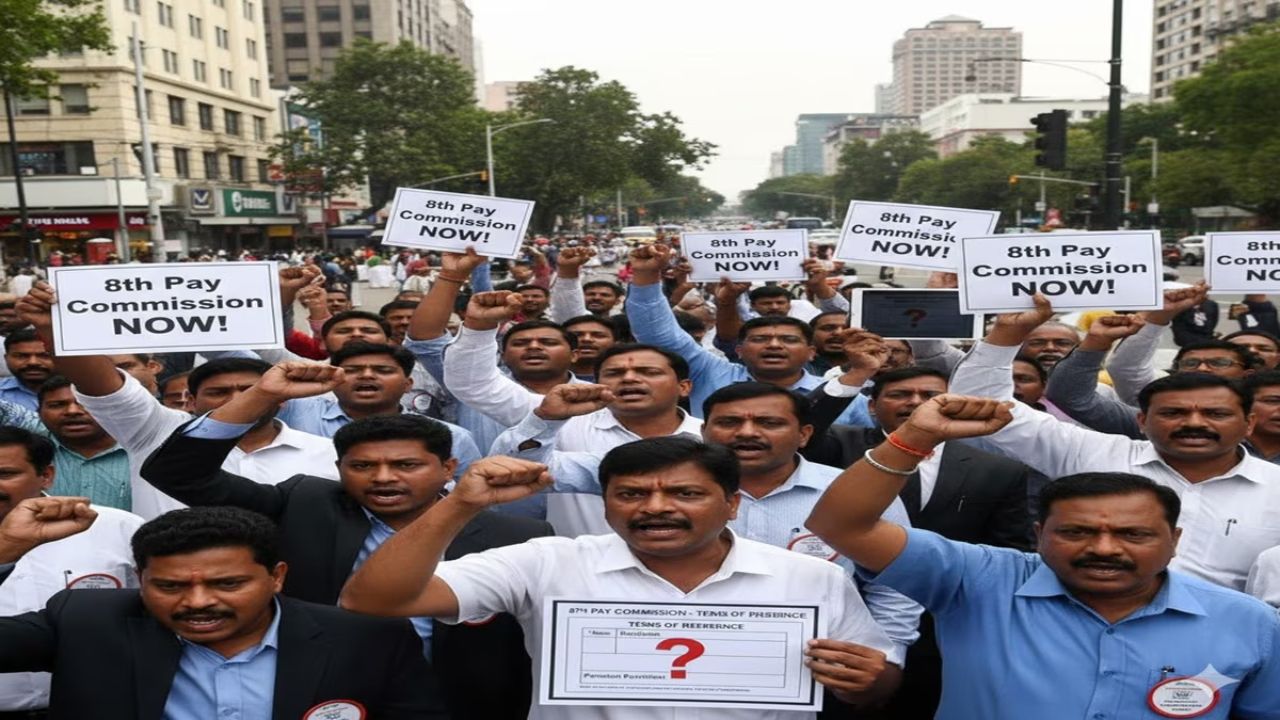
Employee unions have raised concerns since the publication of the ToR
The Union Cabinet had approved the Terms of Reference (ToR) for the 8th Central Pay Commission on October 28. The Commission, headed by former Supreme Court judge Ranjana Prakash Desai, will review salaries and service conditions of nearly 50 lakh central government employees.
Information & Broadcasting Minister Ashwini Vaishnaw stated that the panel is expected to submit its recommendations within 18 months, with the revised pay structure likely to come into effect from January 1, 2026.
The 8th Pay Commission was formally announced in January 2025. Central Pay Commissions are constituted periodically to examine emoluments, retirement benefits, and other service conditions of government employees, with recommendations usually implemented every ten years.
Employee unions have raised concerns since the publication of the ToR. Key issues include the lack of explicit mention of pensioners, absence of a clear implementation date, and deviations from staff-side recommendations on wage revision principles, minimum pay calculation, and measures to address pay compression.
8th Pay Commission: How much will your salary increase? Know here
Unions have also highlighted that the language in the 8th CPC ToR appears more restrictive than in the 7th CPC, potentially limiting the panel’s scope to recommend changes to allowances, pay structure, and pensions.
The Commission will now begin data collection, departmental consultations, and engagement with unions and other stakeholders. With the implementation expected in 2026, debates over allowances, pay structure, and pension revisions are likely to intensify.
Employee unions are expected to continue pressing for measures that safeguard financial security and address inflationary concerns ahead of the next formal pay revision.