 English
 English

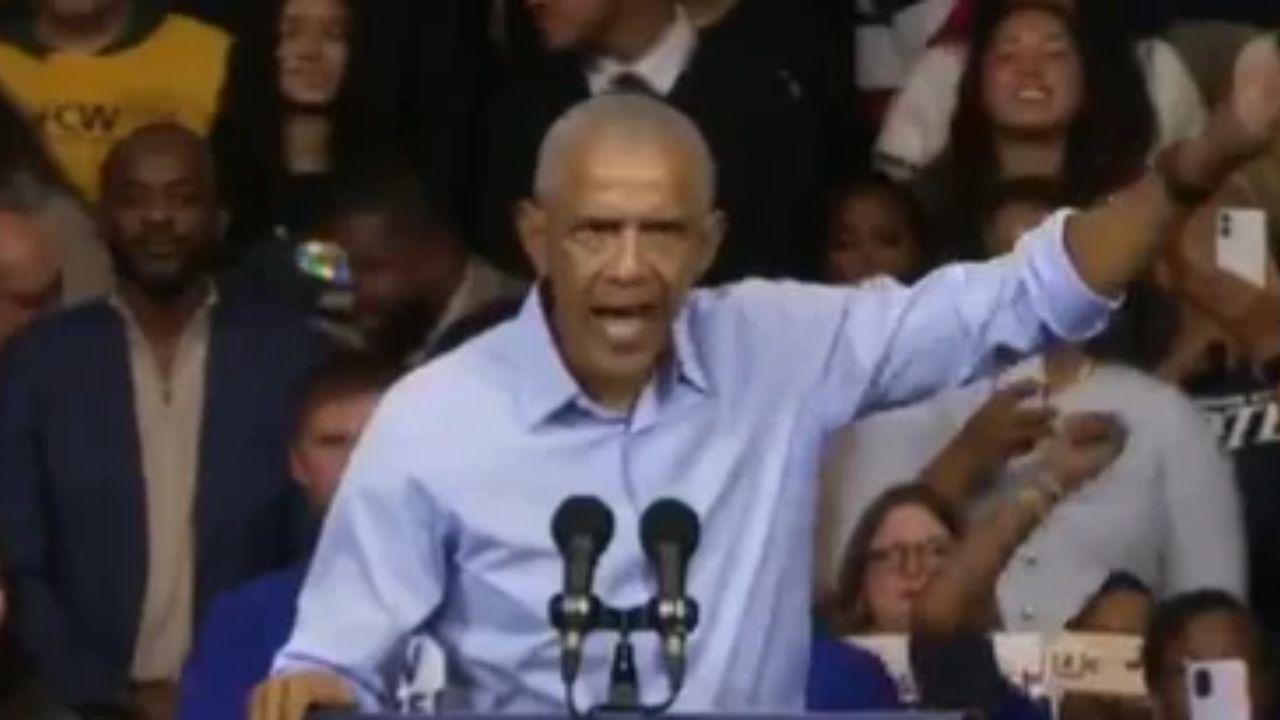
Barack Obama addresses Democratic supporters in Cleveland, Ohio, as he campaigns for Senate candidate Sherrod Brown and gubernatorial candidate Amy Acton ahead of the November 3 midterm elections. (Imng: X)
Cleveland/Detroit: Former US President Barack Obama has returned to the campaign trail with a sweeping indictment of Donald Trump’s second-term leadership, targeting his administration’s handling of the Iran conflict, immigration enforcement, trade policy and the rising cost of living. Addressing Democratic supporters in Cleveland, Ohio, and later in Detroit, Michigan, Obama urged voters to use the November 3 midterm elections to demand greater accountability from the White House.
The rallies on October 24 brought together several high-profile Democratic candidates, including Ohio Senate candidate Sherrod Brown, gubernatorial nominee Amy Acton, Michigan Senate candidate Abdul El-Sayed and gubernatorial candidate Jocelyn Benson. Obama’s intervention came as both states prepared for closely watched electoral contests that could influence the balance of power in Washington.
The former president accused Trump’s administration of making decisions that he argued had contributed to economic uncertainty, damaged America’s international relationships and weakened standards of conduct in public office. He also drew attention with sharp personal jibes at Trump’s White House renovation plans and Defence Secretary Pete Hegseth’s public priorities.
The Iran conflict emerged as one of the central themes of Obama’s criticism. He argued that the administration’s military approach had failed to deliver the security outcomes presented as its original objective, while creating fresh risks for American forces, international partners and global energy markets.
Obama contrasted the current strategy with the nuclear agreement negotiated during his presidency, arguing that diplomacy had offered a way to constrain Iran’s nuclear programme without resorting to military action. He maintained that the Trump administration had abandoned an arrangement he considered effective and questioned the consequences of the subsequent conflict.
Pointing to reported attacks on American allies and military bases, American casualties, hundreds of wounded personnel and pressure on US missile stocks, Obama challenged the administration’s claims of success. He also highlighted Iran’s ability to threaten commercial shipping through the Strait of Hormuz, a critical maritime corridor for global oil supplies.
The former president argued that the resulting uncertainty had strengthened Tehran’s economic leverage and contributed to higher energy costs. With oil prices influencing transport, manufacturing, freight and household expenses, the dispute has become part of a wider political argument over inflation and the cost of living ahead of the midterms.
Obama accused Trump of making a decision that, in his view, had imposed unnecessary costs on Americans. The administration’s supporters, however, have defended its approach to Iran, with the wider debate centring on national security, nuclear proliferation and the consequences of military intervention.
Obama also took aim at Trump’s trade policy, particularly the tariffs imposed on Canada. He questioned the wisdom of escalating a trade dispute with one of the United States’ closest neighbours and longstanding economic partners.
Using humour to make his point, Obama portrayed Canada as an unlikely target for an aggressive trade confrontation, pointing to its close geographical ties and familiar cultural exports. Beneath the ridicule was a broader economic argument: tariffs can raise costs for importers, businesses and consumers, depending on how companies respond to additional duties.
The dispute over tariffs has wider implications for North American supply chains, cross-border manufacturing and the movement of goods. Businesses operating across the US-Canada border can face higher input costs and uncertainty when trade rules change, while consumers may ultimately absorb some of the increase through higher prices.
Obama argued that Trump’s tariff decisions had contributed to the pressure on household budgets. His remarks placed trade policy alongside the Iran conflict as part of his wider criticism of the administration’s economic record.
On immigration, Obama acknowledged that border security and lawful immigration enforcement are legitimate responsibilities of the federal government. He said the border should be orderly and secure, while arguing that those objectives do not require masked federal agents operating in American streets in ways that alarm communities.
Drawing on his own presidency, Obama recalled facing criticism from Democrats when his administration tightened immigration enforcement. He nevertheless distinguished those earlier disputes from what he described as the Trump administration’s approach, raising concerns about reports and allegations involving law-abiding people being arrested, detained or shot.
The issue places immigration enforcement, public safety, due process and the treatment of migrants at the centre of the midterm campaign. The debate is likely to remain contentious as Republicans defend tougher enforcement measures and Democrats question the methods used to implement them.
Obama’s remarks sought to challenge the administration’s approach without rejecting border security as a policy objective, making the distinction between enforcement itself and the conduct of enforcement a key part of his argument.
Trump’s renovation plans for the White House also became a prominent target during Obama’s Cleveland address. The former president mocked the scale and appearance of the changes, suggesting that the president appeared unusually preoccupied with home improvement projects while major policy challenges demanded attention.
Obama drew attention to the proposed ballroom, the alterations to the Rose Garden, a helicopter landing area on the South Lawn and the extensive use of gold-coloured decoration. He used a deliberately provocative comparison to portray the redesigned interiors as excessively lavish, prompting laughter and applause from the audience.
The ballroom project was officially announced in July 2025 and is expected to be completed before the end of Trump’s second term, according to the information available about the plan. The renovations have become a political talking point, with critics questioning their scale and priorities while the administration’s supporters can point to the practical uses of upgraded facilities and event spaces.
For Obama, the issue was not merely interior design. He used the renovation programme to question whether the president’s public priorities reflected the economic and security concerns facing ordinary Americans.
Defence Secretary Pete Hegseth also came under fire as Obama questioned the administration’s emphasis on military image and presentation amid the conflict with Iran. He ridiculed Hegseth’s focus on physical appearance, including the jawlines and testosterone levels of American troops, arguing that such concerns distracted from more consequential questions about military readiness.
Obama’s broader criticism was that national defence requires serious attention to strategy, resources, operational preparedness and the safety of service members. His remarks connected the administration’s public messaging with the challenges he said had emerged during the Iran conflict, including American casualties and pressure on weapons inventories.
The attack added a personal dimension to the former president’s foreign-policy criticism. Rather than focusing solely on the president, Obama sought to portray the administration’s wider leadership as insufficiently focused on the consequences of its decisions.
Obama’s criticism extended beyond policy to questions of ethics, transparency and accountability in government. He accused Trump of using the presidency for personal benefit and argued that the administration’s conduct had lowered expectations for public officials.
He pointed to what he described as potential conflicts involving private business interests, cryptocurrency ventures and taxpayer-funded contracts connected to the president’s family. These were allegations made by Obama as part of his campaign rhetoric, rather than judicial findings established by the rally itself.
The former president also raised concerns about the standards of behaviour in political campaigns, arguing that character and decency should remain important considerations when voters assess public officials.
His remarks reflected a broader Democratic campaign message: that the midterms offer voters an opportunity to scrutinise the administration’s record and demand greater oversight. Republicans have defended Trump’s leadership and policies, while the White House did not immediately respond to a Reuters request for comment on the criticism reported by the news agency.
In Ohio, Obama also addressed a controversy surrounding Republican gubernatorial candidate Vivek Ramaswamy’s attack advertisement targeting Democratic rival Amy Acton. The advertisement featured Acton’s estranged mother disputing her account of a childhood marked by homelessness and sexual abuse by her stepfather.
Acton has said she has not seen her mother since 1978. Her brother has supported her account of childhood sexual abuse, and the stepfather was charged with rape before his death in 2004.
Obama defended Acton, highlighting the painful experiences she has publicly described and questioning the standards of political campaigning that allowed such an advertisement to be aired. His intervention placed the dispute over personal history and campaign ethics directly into Ohio’s gubernatorial race.
Trump defended the advertisement on Saturday after casting his early ballot in Florida. The controversy has become a flashpoint in a closely watched contest between Acton and Ramaswamy, with the candidates’ supporters offering sharply different assessments of the advertisement and its use in the campaign.
After his Cleveland appearance, Obama travelled to Detroit to campaign for Democratic Senate candidate Abdul El-Sayed and gubernatorial candidate Jocelyn Benson. There, he challenged attacks directed at El-Sayed, arguing that the candidate’s name and Muslim faith were being used to undermine his political standing.
Obama compared the attacks with the false claims about his own birthplace that surfaced during his political career. He presented El-Sayed as a candidate whose Michigan roots and policy positions should be judged on their merits, rather than through insinuations about his identity or religion.
The former president also highlighted the prospect of El-Sayed and a woman from a different religious background working together in the Senate, using the example to underscore the diversity of the electorate. El-Sayed is competing against Republican Mike Rogers in a race that could have implications for control of the chamber.
Obama described the November 3 election as a potential mechanism for restoring accountability and limiting what he regards as excesses of the Trump administration. His appearances in Ohio and Michigan form part of a broader effort by Democrats to mobilise supporters in the final stretch of the midterm campaign.
The US midterm elections are held halfway through a president’s four-year term and determine control of the House of Representatives and a portion of the Senate. The outcome can shape the administration’s ability to pass legislation, approve spending, conduct oversight and advance its policy agenda.
Obama’s rallies were designed to bring national attention to competitive state races while framing the election as a referendum on Trump’s leadership. By linking foreign policy, tariffs, immigration enforcement, public conduct and the cost of living, he sought to connect national controversies with voters’ everyday concerns.
The campaign is also a test of the Democratic Party’s ability to convert enthusiasm at rallies into voter turnout. For Obama, the central message was that public accountability depends on participation at the ballot box. With the November 3 vote approaching, his return to the campaign trail has placed the president’s record and the direction of US politics firmly in the spotlight.