English
 English

BJP and Congress face off over Vande Mataram after the BJP passed a resolution protecting the complete six-stanza version.
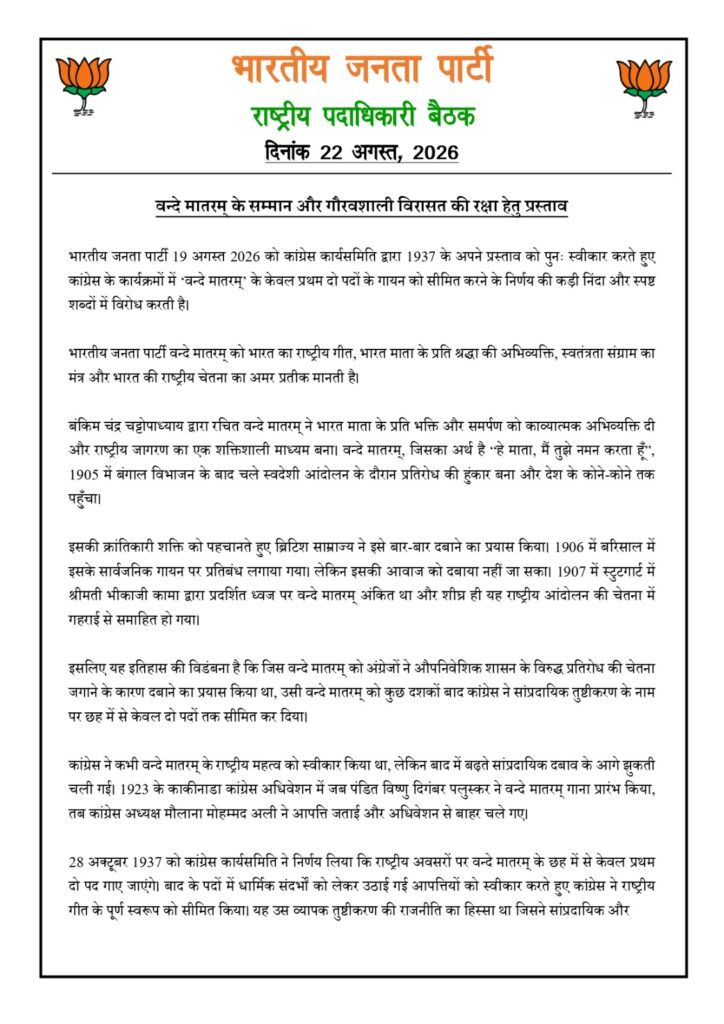
New Delhi: The decades-old debate around Vande Mataram has entered a fresh political phase, with the BJP and Congress locking horns over the recital, legacy and historical significance of India’s national song. The controversy escalated after the saffron party passed a resolution on Saturday, asserting that the complete version of Vande Mataram must be protected, while strongly opposing the Congress Working Committee’s decision to limit its recital to two stanzas during party events.
The BJP’s resolution, passed during a meeting of its newly appointed national office-bearers at the party headquarters in New Delhi, has turned the issue into a major political flashpoint. The meeting was chaired by BJP national president Nitin Nabin, where party leaders recited all six stanzas of Vande Mataram before the proceedings began, signalling the party’s position on preserving the full composition.
BJP maintained that Vande Mataram is not merely a patriotic song but a symbol deeply connected with India’s freedom struggle, national consciousness and cultural identity. The party said the complete six-stanza version represents the sacrifices, struggles and aspirations of generations of Indians who fought against British colonial rule.
The political confrontation began after the Congress Working Committee on August 19 decided that Vande Mataram would continue to be sung at Congress programmes but only its first two stanzas would be used.
Congress defended the decision by referring to its historical position from 1937 and maintained that its approach was aligned with the decisions taken during that period by prominent national leaders, including Mahatma Gandhi, Jawaharlal Nehru and Sardar Vallabhbhai Patel.
BJP, however, launched a sharp counterattack, accusing Congress of undermining the broader legacy and historical importance of the national song. The ruling party argued that reducing the recital to two stanzas ignores the emotional and political significance attached to Vande Mataram during India’s independence movement.
The issue has now transformed into a larger ideological battle, with both parties presenting competing narratives over nationalism, historical interpretation and the role of national symbols in public life.
As part of its response, the saffron party announced a nationwide campaign aimed at spreading awareness about the origin, history and significance of Vande Mataram. The party said the campaign would particularly focus on young Indians and highlight how the song became a source of inspiration for freedom fighters during the anti-colonial movement.
According to the party, the objective of the campaign is to ensure that future generations understand the historical journey of Vande Mataram and its association with India’s struggle for independence. The party said its workers would take the message of the national song’s heritage and contribution to different parts of the country through public outreach programmes.
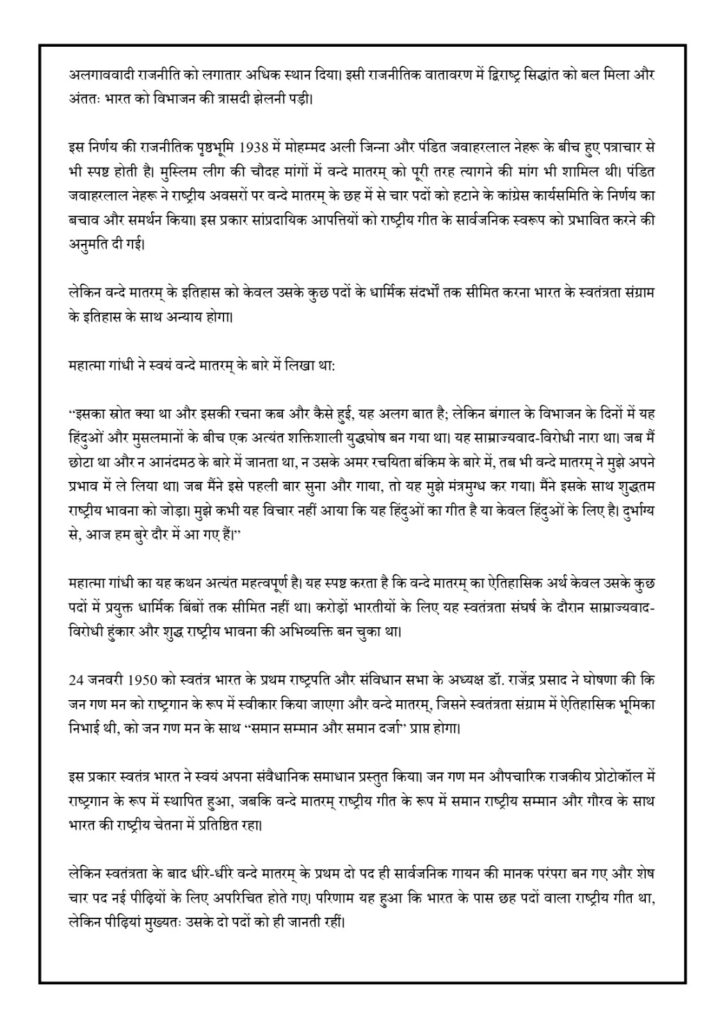
The resolution also highlighted Mahatma Gandhi’s views on Vande Mataram and referred to the song’s role as an anti-imperialist expression during the freedom movement.
The party argued that Vande Mataram became a powerful symbol of resistance against British rule and inspired countless Indians during the fight for independence. It maintained that the significance of the national song should be understood beyond present-day political calculations and viewed through the larger historical context of India’s freedom struggle.
The Vande Mataram controversy has added another layer to the ongoing ideological rivalry between the BJP and Congress. BJP leaders accused Congress of compromising on a national symbol due to political considerations, while Congress maintained that its decision was based on historical resolutions and traditions.
The issue gained further momentum after BJP leaders accused Congress president Mallikarjun Kharge and party parliamentary chairperson Sonia Gandhi of showing disrespect during the playing of Vande Mataram at Independence Day celebrations on August 15.
BJP demanded an explanation from Congress over the matter. The grand old party has rejected the criticism and maintained that its position is based on historical context rather than any attempt to diminish the importance of the national song.
Union Home Minister Amit Shah also criticised the Congress Working Committee’s decision, alleging that the move reflected what the BJP described as a politics of appeasement. BJP leader Sambit Patra launched a strong attack on Congress, underlining the importance of the complete six-stanza version of Vande Mataram and linking it with the sacrifices of India’s freedom fighters.
The saffron party has positioned the issue as a matter of national heritage and cultural preservation, while Congress has framed its stand as a continuation of historical decisions.
The Vande Mataram row has triggered widespread discussion across social media platforms, with citizens debating the importance of national symbols, historical traditions and political interpretations.
For many Indians, Vande Mataram remains closely associated with patriotism, national pride and the freedom movement. The latest controversy has brought renewed attention to the history and meaning of the iconic song.
Political observers believe the debate could continue to influence public discourse as parties increasingly focus on issues related to nationalism, cultural identity and historical legacy.
The saffron party is expected to begin its nationwide campaign highlighting the significance of Vande Mataram, while Congress is likely to continue defending its decision regarding the recital of the song at party programmes.
With both political parties maintaining firm positions, the Vande Mataram controversy is set to remain a major talking point in Indian politics, reflecting the broader contest over national identity, historical narratives and cultural symbolism.