 English
 English

Supreme Court of India (Image Source: Internet)
New Delhi: On January 29, 2026, the Supreme Court of India began hearing a batch of petitions challenging the University Grants Commission’s (UGC) newly notified regulations. The petitioners argued that the new rules are unconstitutional, discriminatory, and contrary to the spirit of equality guaranteed under Article 14 of the Constitution.
Senior counsel representing the petitioners stated that the Constitution provides protection to all citizens and that no group should be selectively identified or excluded. According to the petitioners, the new rules create confusion and institutionalize discrimination by explicitly mentioning only OBC, SC, and ST categories.
Supreme Court to hear plea challenging UGC regulations 2026 today; Details here
The petitioners’ lawyer argued that Rule 3(e) of the UGC regulations already contains a comprehensive definition of discrimination. In that context, the introduction of Rule 3(c), which specifically refers to certain social categories, was questioned. The lawyer contended that assuming discrimination can occur only against specific communities is flawed and risks deepening social divisions.
The counsel clarified that discrimination can affect individuals across regions, languages, and cultures, but deliberately refrained from listing multiple examples to avoid unnecessary complexity.
Responding to the arguments, Chief Justice of India (CJI) Suryakant observed that the Court’s primary concern was to assess whether the new rules comply with Article 14, which guarantees equality before the law. The Court made it clear that it was not interested in hypothetical illustrations beyond what was necessary to judge constitutional validity.
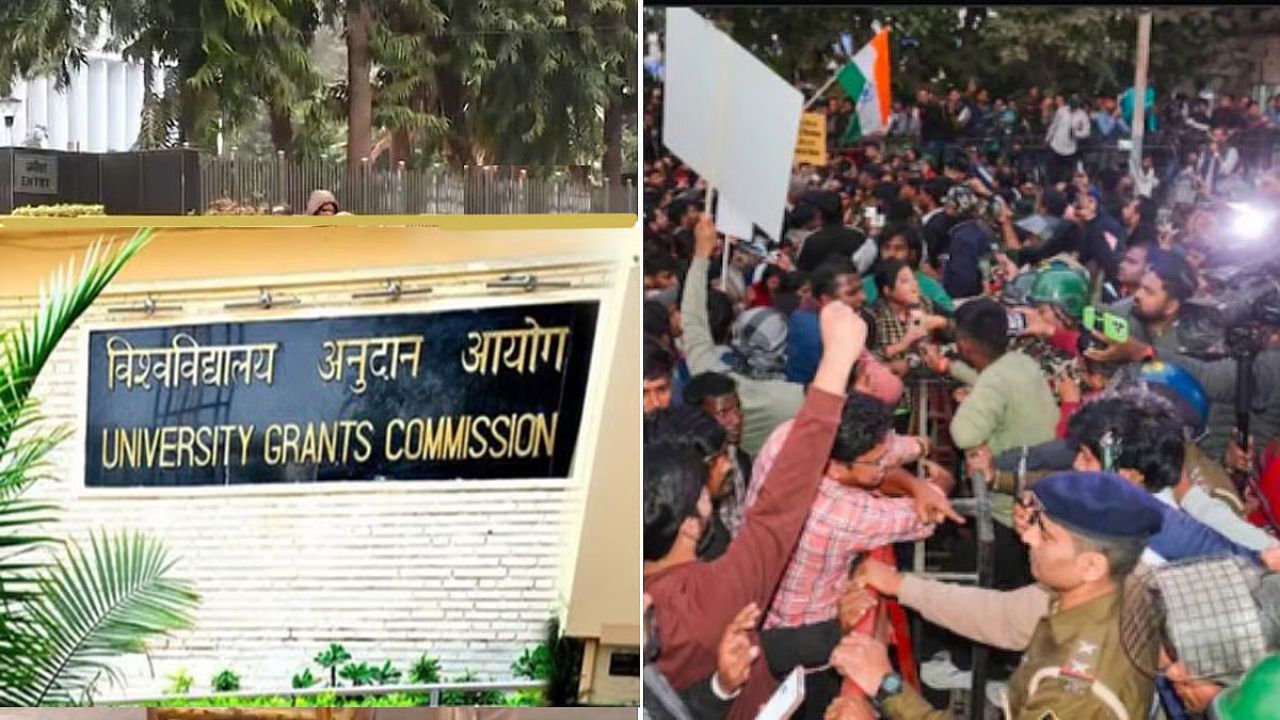
UGC’s new equity rules have triggered protests nationwide
The CJI posed a hypothetical situation: if a student from South India faces discriminatory remarks in a North Indian college, would that fall within the definition under Rule 3(e)? The petitioners’ lawyer answered in the affirmative, reinforcing the argument that a separate provision for certain castes was unnecessary.
After hearing the arguments, the Supreme Court stayed the implementation of the new UGC rules. The Court directed that the 2012 regulations would continue to remain in force for the time being. The Centre has been asked to file its response by March 19, 2026, which is also the date of the next hearing.
While granting the stay, CJI Suryakant raised a larger concern about the direction society is moving in. He questioned whether India is progressing towards a casteless society or moving backward. He noted that students from diverse backgrounds live together in hostels, and warned that the new rules could lead to segregation, which should be avoided.
Why UGC’s new equity regulations triggered nationwide student protests? Explained
Justice Bagchi also emphasized that laws and policies should strengthen unity and social cohesion rather than fragment society.
The Chief Justice stated that the Court would seek the government’s explanation and indicated that an expert committee could be formed to examine the implications of the rules. He cautioned that such regulations could be misused by certain sections if not carefully framed.